Blythe Construction, a leading heavy civil contractor in the Southeastern U.S. specializing in roads, bridges, railways, and large site development. They are also part of the global Eurovia VINCI network, and faced a recurring challenge on the I-485 Express Lanes project in Charlotte, North Carolina. The survey team needed a faster and safer way to perform road layout during night shifts, where long work windows, strict accuracy requirements, and limited visibility increased operational pressure. Traditional layout methods using tape measures, string lines, and manual spray paint slowed progress and created opportunities for human error. With tight deadlines and a large corridor divided into 4 sections, the team sought a solution that would significantly improve efficiency while maintaining precision.
Challenges:
Manually marking even a 1-mile stretch often required an entire night shift. The work was repetitive, physically demanding, and difficult to execute consistently across long distances. Surveyors needed to achieve high accuracy to meet Department of Transportation specifications, and manual methods made that level of precision harder to maintain. Surveyor Austin Ford explains the impact on workflow.
"Before we had the robot, laying out a long stretch of highway could take a 2-3 crew an entire shift. We often spent 7 to 8 hours on the task, and with CivDot Mini we cut it to 2 to 3 hours for the same layout task."
Across multiple sections of the project, these extended layout times created bottlenecks and slowed downstream construction activities.
Solution:
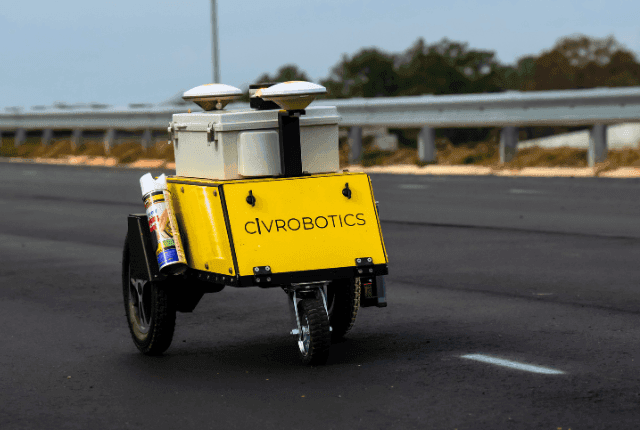
To address these challenges, Blythe Construction introduced a CivDot Mini robot into their surveying workflow. CivDot Mini uses Dual RTK GPS and an inertial sensor to autonomously navigate across the job site and lay out the lines according to digital design files. Blythe’s team uploaded DXF files into the CivPlan to select which lines to mark and ability to choose between points, dashes and solid lines. They can even customize the spacing and length of the dashes as they please. Once deployed, the robot executed the layout with consistent, sub-inch precision. Over 8 months of operation on both night and day shifts, the CivDot Mini demonstrated reliable performance even in demanding field conditions with a need for only one operator. Ford notes that robotics improved both productivity and consistency across all shifts.
Results: faster progress, consistent quality, and improved safety
With CivDot Mini, layout time dropped from 7 to 8 hours of a 2-3 person crew to just 2 to 3 hours with a single operator. Accuracy also improved. CivDot Mini followed digital plans precisely vs pulling tapes, enabling design updates to be applied immediately and eliminating variability common in manual marking. With less physical layout work required, survey crews were able to redirect their efforts toward oversight, planning, and quality control.
A new standard for highway layout
The I-485 project marks Blythe Construction’s first deployment of our newly advanced CivDot Mini, and the results have encouraged interest in expanding robotic layout across additional projects. The improvements in speed, precision, and safety helped remove layout as a long-standing constraint in highway construction.

Blythe Construction, Inc. stands as a dominant force in heavy civil construction, leveraging over a century of unparalleled expertise to shape the infrastructure of the southeastern United States.
Use Case: CivDot Mini
Project Size: 18 Miles road
Projects with CivDot Mini: 1
Discover the power of CivDot Mini
Get a demo ->>

© 2026 Civ Robotics inc. All Rights Reserved.