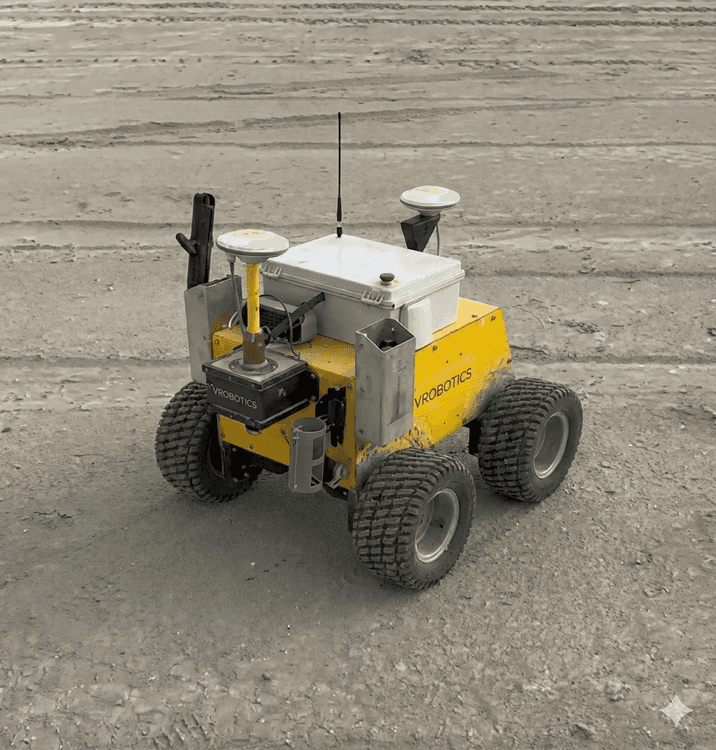
Most surveying firms do not struggle with demand. They struggle with production capacity. In construction layout and construction staking, the typical workflow is still manual. A crew chief operates the rover while a rodman assists with positioning and marking. Even with reliable GNSS technology, that manual marking process usually results in 400 to 500 points per day. That output becomes the ceiling.
When the crew chief must stay in the field to maintain precision and pace, the business can only grow as fast as the crew can physically move. Larger construction layout projects become harder to accept, and scaling requires hiring instead of increasing throughput.
What Is an Autonomous Layout Robot?
An autonomous layout robot is a field-deployed system that uses GNSS positioning and robotic marking to automatically mark construction layout points with high precision, reducing manual staking labor. Instead of manually marking every point, the robot automates the repetitive portion of surveying layout, allowing crews to focus on higher-value work.
From Manual Marking to 1,500 Points Per Day
CivDot+ changes the production model for small surveying firms. Instead of two people completing 400 to 500 points per day, one operator can mark between 1,000 and 1,500 points per day with 3/100 ft 8 mm accuracy.
The rodman can operate the system independently after remote training. The interface is simple and designed for field conditions, so adoption does not require robotics specialists or workflow disruption.
This shift frees the crew chief to manage multiple jobs, oversee quality control, bid larger construction layout scopes, and focus on business growth instead of standing on every point.
Built to Work With Existing GNSS Systems
For small surveying firms, replacing infrastructure is not practical.
CivDot+ can connect to an existing base station and support job site calibration files. There is no need to replace total stations or existing GNSS equipment.
The workflow remains familiar. The production capacity increases.
Case Study: Avanza Topografía
Avanza Topografía, a small surveying firm, faced the typical 500-point production ceiling.
After implementing CivDot+, their daily output increased to between 1,000 and 1,500 points. Remote training accelerated adoption, and the firm maintained its existing GNSS workflow.
Most importantly, leadership time shifted from repetitive field marking to engineering and business development. The firm increased capacity without increasing headcount.
Why This Matters for Small Surveying Firms
Moving from 400–500 points to 1,000-1,500 points per day expands:
- Revenue capacity
- Project throughput
- Bid competitiveness
- Leadership leverage
You are not replacing your crew. You are increasing what your crew can produce with automation.
Frequently Asked Questions
How many points can an autonomous layout robot mark per day? This is a tricky question, it really depends on accuracy requirements and spacing. Anywhere from 1000-3000 points a day.
Does a layout robot replace a survey crew? No. It increases the output of an existing crew by automating repetitive construction staking and surveying layout tasks. It enables your crew chief to focus on more complex layout tasks and have the nailer focus on the layout.
Does CivDot+ require replacing GNSS technology? No. It can connect to an existing base station and support job site calibration files, integrating into current workflows.
Is the system difficult to learn? No. The interface is built for field simplicity, and training can be delivered remotely, allowing crews to become operational quickly.
Ready to Increase Construction Layout Output?
Most l surveying firms estimate between 200-400 is points per day, there may be untapped production capacity in your operation.
CivDot+ helps small surveying firms increase construction layout productivity while keeping their existing GNSS systems and team structure intact.
Schedule a demo to see how it fits into your workflow.

© 2026 Civ Robotics inc. All Rights Reserved.